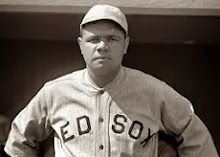
Didn't want to hurt his feelings
Labels: baseball as redemption, obituaries
posted by John at 8:49 AM
0 comments


Musings on the convergence of baseball and politics...because, "What is government itself, but the greatest of all reflections on human nature?" Surely, Madison would have said the same of baseball.
Labels: baseball as redemption, obituaries
posted by John at 8:49 AM
0 comments
As far as sports holidays go, if the Super Bowl is Christmas (commercialized and nationalized to the extent that many of those who celebrate it do so without any acknowledgement of the day’s meaning), and Opening Day is Thanksgiving (a properly national holiday that surprisingly retains a sort of understated warmth and significance), then Pitchers and Catchers is Groundhog’s Day, a day we all know is meaningless, but whose promise of spring in the latter days of a long, cold winter, proves irresistible nonetheless.
Labels: baseball as redemption, spring training
posted by John at 11:35 AM
0 comments
It is high, it is far, it is gone.
Labels: baseball as redemption
posted by John at 1:25 PM
0 comments
But for me, the story of this game was Colin Curtis, a 25-year-old prospect drafted in 2006 out of Arizona State. He lined out in his major league debut on Monday night, but on Tuesday night Joe Girardi sent him out to pinch hit for Pettitte with two outs in the top of the eighth. The Yankees had already put the game moderately out of reach by scoring four runs in the frame, bringing the lead to 7-2, so there was really no pressure at all on Curtis. He took a ball and then a strike before launching a fastball to the wall in center field. Two more runs scored and Curtis ended up on second with a double, his first major league hit.
His eyes went to the ball, tracking it as it came in to the infield and found its way to second base umpire Laz Diaz. I’ve never been on the field in these moments, so I always wonder how it is that everyone on both sides immediately knows that the ball needs to be saved, but they always do. As Robinson Canó crossed home plate, he immediately began signaling for the ball. For his part, Diaz got Curtis’s attention, pretended to tuck the ball back into his pocket to be used again, then laughed as he tossed it towards the Yankee dugout. Curtis was suddenly eight-years-old again, and he grinned from ear to ear. The YES cameras found his family in the stands, focusing on his older brother who was high-fiving everyone within reach.
Labels: baseball as redemption
posted by John at 1:01 PM
0 comments
Labels: baseball as redemption
posted by John at 1:27 PM
0 comments
Labels: baseball as redemption
posted by John at 5:36 PM
0 comments
Labels: baseball as redemption, Greek God of Walks, OBP Jesus
posted by John at 3:00 PM
0 comments
Labels: baseball as redemption
posted by John at 11:16 AM
0 comments
Matsui was one of two Yankees coming off four-year, $52 million contracts. The idea of a pay cut initially offended the other, Johnny Damon, who took until last week to sign for one year and $8 million with Detroit. Matsui took less but signed earlier, accepting his standing in the market.
“At least for me, personally, it doesn’t really bother me,” Matsui said. “You have to take into consideration what the current market is and also your worth as a player, how teams assess you. My market price four or five years ago was different because my age was different.”
He added: “In my mind, it wasn’t so much about money. It was more about the situation, the conditions, going to a winning team, and also having the opportunity to play every game, hopefully. And then also — whether I can do it or not, putting that aside — at least having a chance to play the outfield. That is what really drove my decision.”
Well, he may be a trifle deluded to think he can still make a meaningful defensive contribution, but his off-season decisions were a poignant contrast to the sad Johnny Damon parade.
Hideki Matsui wrapped his fingers around his lips, making a megaphone with his left hand. In a deep voice that needed no translation, he bellowed a sound he did not hear often in seven seasons with the Yankees: “Booooooo!”
Matsui was guessing how the crowd would react at Yankee Stadium next month if the Yankees bestow a championship ring on a visiting player. The Los Angeles Angels, Matsui’s new team, are the first visitors to the Bronx this season, with a three-game series starting April 13.
“I don’t know what it’s going to be like,” Matsui said through his interpreter, Roger Kahlon, after an Angels practice at Tempe Diablo Stadium on Tuesday. “It’s kind of weird, because I’ll be wearing a different uniform. Will I be part of the ceremony? I don’t know if we’re all supposed to be wearing casual clothes.”
I can promise him that the cheers will be rapturous.
Labels: baseball as redemption, Hideki Matsui
posted by John at 11:18 AM
0 comments
Labels: baseball as redemption
posted by John at 10:17 AM
0 comments
Whether you consider McGwire a Hall of Famer or not depends on the degree of outrage you feel over steroid use, that is, over the dishonest act rather than the effects of the cheating, because (again) when it comes to the latter, we just don’t know. The problem is that we’re now talking about matters of character rather than performance, surely a hypocritical and subjective thing to be doing. Let he who is without sin etcetera, etcetera and so forth. The Hall of Fame is already so compromised, so corroded with the sanctimonious drool of so many writers and their quasi-religious “first year” rule and odd embrace of Jim Rice, the way they betrayed the elderly Buck O’Neill, that it’s difficult to make any qualitative argument and instead say simply this: the Hall of Fame is the museum of baseball. For better or worse, Mark McGwire was an exemplar of a certain kind of baseball, just like Cap Anson was an exemplar of another kind. Like it or not, those years happened, those events happened, and we should keep remembering them, keep talking about them forever. Hell, yes, Mark McGwire should be in. We made him and he’s ours, so we should keep him.
Labels: baseball as redemption
posted by John at 3:49 PM
0 comments
Labels: baseball as redemption
posted by John at 1:43 PM
0 comments
On the surface, Henrich’s Triple Crown numbers don’t sound like that of a Hall of Famer: .282 batting average, 183 home runs, and 795 RBIs. But let’s look at what could have been. Henrich missed three full seasons in the midst of his prime—his age 30, 31, and 32 seasons—while serving in the U.S. military during World War II. If Henrich had been able to play and post even “average” seasons during that span—let’s say 20 home runs and 85 RBIs per season—he would have finished his career with over 240 home runs and over 1,000 RBIs. Those are far more impressive numbers, especially within the context of Henrich’s percentages. For his career, Henrich compiled an on-base percentage of .382 and a slugging percentage of .491, both favorable numbers. On top of that, Henrich was a smart, disciplined hitter who walked nearly twice as often as he struck out. He also played a solid defensive right field, helping to form one of the great outfields in baseball history, teamed with Joe DiMaggio in center and the similarly overlooked King Kong Keller in left. Finally, let’s throw Henrich’s four world championship rings into the argument, and suddenly we have a far more viable candidate for the Hall of Fame.
I’m a firm believer that Hall of Fame candidates who lost playing time during the war deserve some kind of “war credit” for what they might have achieved. After all, these men often had no choice but to enlist in the military; many of them also felt a civic and patriotic duty to do so. Their responsibility and bravery should not be held against them. The crux of the matter is this: exactly how much war credit do we give these players for time lost in service? Each case varies, given the length of military service and the time that it occurred within a player’s career. In the case of Henrich, he enjoyed three of his finest seasons after the war, so it’s reasonable to assume that the three years he lost fell in the midst of what we should rightfully consider his peak or prime. That becomes a huge chunk of war credit, and perhaps it’s enough to put Henrich right on the Cooperstown village limits.
Labels: baseball as redemption
posted by John at 12:37 PM
0 comments
Labels: baseball as redemption, baseball is cruel
posted by John at 6:22 PM
0 comments

Labels: baseball as redemption, Hot Stove
posted by John at 12:20 PM
0 comments
Labels: baseball as redemption, baseball is cruel
posted by John at 10:04 AM
0 comments
Labels: baseball as redemption
posted by John at 9:21 AM
0 comments